Ceiling Curtain Brackets: Low-Profile Hardware for Ceiling & Wall Installation
When wall space is limited, windows run all the way to the ceiling, or you want the clean look of curtains dropping from directly overhead, ceiling curtain rod brackets are the right solution. A Key Tech ceiling brackets are low-profile, built from durable aluminum alloy, and designed to mount securely to ceilings or walls — whichever your project calls for. Each set ships with three complete installation kits covering ceiling drywall, concrete and brick, and wall installation, so you have the right hardware for any surface right in the box. Available in multiple finishes to complement any interior.
25 lbs per bracket (wall-stud tested) | Ceiling or wall mount | Hidden screws | Three installation kits included | Low-profile design
Ceiling Curtain Rod Brackets — Sets of 2 & 3
Our low-profile ceiling curtain brackets fit rods between 3/4 and 1 inch in diameter and mount to ceiling or wall surfaces with equal ease. The bracket hook design secures the rod securely in both orientations. Hidden screws keep the look clean and finished. Every set includes three installation kits — ceiling butterfly screws, threaded drywall anchors for wall installation, and concrete and brick anchors — so any surface is covered.
-
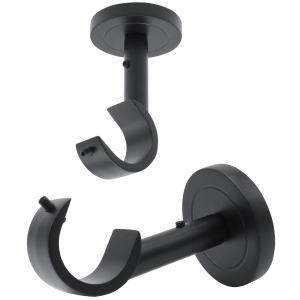
Ceiling Curtain Rod Brackets, 3 Inch Low Profile, Ceiling or Wall Mount, Black, Set of 2
$19.99 Buy on Amazon -
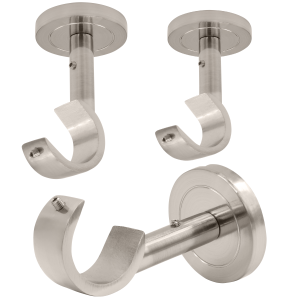
Ceiling Mount Shower Curtain Rod Brackets, 3 Inch Low Profile, Brushed Nickel, Set of 3
$27.99 Buy on Amazon -
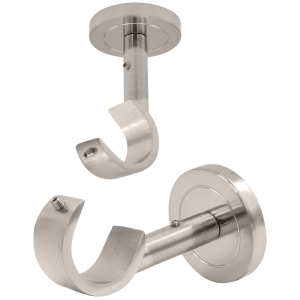
Flush Mount Curtain Rod Brackets, 3 Inch Short Projection, Wall or Ceiling, Brushed Nickel, Set of 2
$19.99 Buy on Amazon -
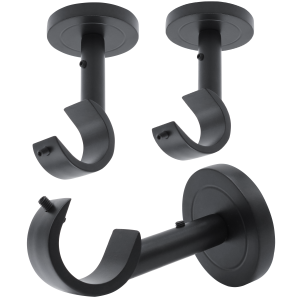
Long Ceiling Mount Curtain Rod Brackets with Center Bracket, 3 Inch Low Profile, Black, Set of 3
$27.99 Buy on Amazon
What makes A Key Tech ceiling brackets work
Short Profile Reduces Lever Effect
The shorter the arm between the ceiling and the rod, the less torque is placed on your ceiling anchors every time you open or close a curtain. Our low-profile design keeps the rod close to the ceiling surface — minimizing that leverage force and keeping the installation secure and stable through years of daily use.
Ceiling or Wall — Both Work
The bracket hook design supports the rod securely whether the bracket is mounted on the ceiling or the wall. This makes our ceiling brackets an exceptionally versatile option — use them overhead for a true ceiling mount, or on the wall for a minimal, low-profile look that keeps the rod close to the wall surface.
Three Installation Kits Included
Most bracket sets include one type of anchor. A Key Tech ceiling brackets include three complete installation kits — ceiling butterfly screws for drywall ceilings, threaded drywall anchors for wall installation, and concrete and brick anchors for masonry surfaces. No matter what your ceiling or wall is made of, the right hardware is already in the box.
Hidden Screws for a Clean Finish
Ceiling brackets are visible from below — which makes the finish more important than on wall-mounted hardware. A Key Tech ceiling brackets use hidden screws throughout, so the bracket surface facing down into the room is clean and seamless, not cluttered with exposed hardware or screw heads.
Ceiling brackets vs. wall brackets — which is right for your project?
| Feature | A Key Tech Ceiling Bracket | A Key Tech Wall Bracket (Extended) |
|---|---|---|
| Mounting surface | Ceiling or wall | Wall only |
| Profile / arm length | Low-profile — 3″ projection | Extended — 5″ or 6″ |
| Bracket material | Aluminum alloy | Aluminum alloy or steel |
| Max load per bracket | 25 lbs (wall-stud tested) | 25 lbs (wall-stud tested) |
| Rod diameter | 3/4″–1″ | 1″ (most models also 3/4″) |
| Hidden screws | Yes | Yes |
| Installation kits | 3 kits (butterfly + drywall + masonry) | 2 kits (drywall + masonry) |
| Best for | Floor-to-ceiling looks, room dividers, shower installations, windows without wall space | Clearing blinds, deep window trim, sliding door hardware |
| Pack sizes | Sets of 2 or 3 | Sets of 2, 3, or 4 |
The floor-to-ceiling curtain look — why ceiling mounting makes it work
Mounting curtain rods from the ceiling rather than the wall is one of the most effective design moves in contemporary interior design. When a curtain drops from ceiling height all the way to the floor, it creates a continuous vertical line that makes the room feel taller, the windows feel larger, and the overall space feel more refined and intentional.
The key to getting this right is starting as close to the ceiling as possible. Standard wall brackets mounted even a few inches below the ceiling create a visible gap between the top of the curtain and the ceiling surface — breaking the visual line and reducing the effect. Ceiling mount brackets eliminate this gap entirely, letting the curtain begin right at the ceiling plane and fall in one uninterrupted line to the floor.
Measuring curtain length for a ceiling mount installation
Getting the curtain length right for a ceiling mount installation depends on a few variables that are worth thinking through before you buy fabric or ready-made panels.
The gap between ceiling and rod
Because our brackets are low-profile, the rod sits close to the ceiling — but not flush against it. The exact gap depends on your specific bracket and ring combination, so always measure from the ceiling surface down to where the top of your curtain will actually hang, not just to the rod itself.
How your curtains attach to the rod
Tab-top curtains, eyelet/grommet curtains, curtains on rings, and curtains on hooks all hang at different heights relative to the rod. A curtain on a deep ring hangs lower than one with a small clip — which means the same panel length will result in a different floor clearance depending on the attachment method you use.
Where you want the curtain to end
A curtain that skims the floor, one that puddles slightly, and one that clears the floor by an inch all require different lengths. Decide on the look you want before calculating — and keep in mind that floor-to-ceiling curtains are most forgiving when they skim or puddle slightly rather than trying to hit an exact floor clearance.
Our recommendation
Once your brackets are installed, hang a tape measure from where the top of your curtain will sit — accounting for your specific attachment method — down to the floor. That measurement is your curtain length. It takes a few extra minutes but removes all the guesswork and ensures you get the result you’re looking for.
Mounting into different ceiling types
A Key Tech ceiling brackets include installation kits for all common ceiling surfaces. Here is how to approach each one.
Drywall Ceiling
The most common residential ceiling type. Use the included ceiling butterfly (toggle) screws for a secure hold in drywall. For maximum strength, locate a ceiling joist with a stud finder and drive the screws directly into solid wood — a joist mount is always stronger than a drywall anchor alone.
Concrete or Brick Ceiling
Found in high-rise buildings, older construction, and industrial loft spaces. Use the included concrete and masonry anchors — pre-drill a pilot hole, insert the anchor, then drive the screw to secure the mounting plate firmly. No extra trip to the hardware store needed.
Wall Installation
When mounting on a wall instead of the ceiling, use the included threaded drywall anchors — these screw directly into drywall without pre-drilling and provide a firm, reliable hold for wall-mounted applications. Concrete and brick anchors are included for masonry walls as well.
When in Doubt
If you’re unsure about your ceiling material, anchor selection, or the load your installation needs to support, we always recommend consulting a professional installer before proceeding. Getting the installation right from the start is always easier than fixing it after the fact.
Popular uses for ceiling curtain brackets
Floor-to-Ceiling Curtains
The most popular use case — mounting directly from the ceiling creates a dramatic, uninterrupted curtain drop that makes any room feel more elegant and spacious. Works beautifully in living rooms, bedrooms, and dining spaces where you want the window treatment to be a design statement.
Room Dividers
In open-plan spaces, studios, and lofts, ceiling mounted curtain brackets are the practical anchor for room divider curtains — because there are often no walls available to attach to. A ceiling-mounted rod lets you create flexible, temporary privacy across any span of open space.
Bathroom & Shower Curtains
Ceiling mounting is increasingly popular for shower curtains — particularly when tiling makes wall drilling impractical, or when you want a spa-like, floor-to-ceiling effect. Our brackets are tested for use in humid environments, making them a reliable choice for bathroom applications. Note that more intensive moisture exposure will affect the long-term lifecycle of the product.
Windows Without Wall Space
Basement windows that run all the way to the ceiling, windows directly adjacent to door frames or wall corners, or any situation where there simply isn’t enough wall space above the window for standard brackets — ceiling mounting solves all of these cleanly without awkward workarounds.
Blackout Installations
Mounting from the ceiling minimizes the gap between the top of the curtain and the ceiling surface — one of the most common sources of light bleed in blackout installations. For bedrooms and home theaters where maximum light control matters, ceiling mounting gives you the tightest possible seal at the top of the curtain.
Trade & Multi-Room Projects
Interior designers and contractors appreciate that our ceiling brackets deliver consistent quality and finish across every unit — whether you’re outfitting one room or an entire floor. Available in sets of 2 or 3. Learn more about wholesale curtain brackets.
Finishes — visible from every angle
Because ceiling brackets are often visible from below — particularly when used for room dividers or in open spaces — finish quality matters more than on wall-mounted hardware. A Key Tech ceiling brackets are available in multiple finishes designed to complement modern interiors and remain visually consistent in varied lighting conditions throughout the day.
Our matte black finish is non-reflective, making the hardware sit quietly in the shadow line near the ceiling without drawing attention. Our brushed nickel provides a warm, refined tone that works across transitional and contemporary spaces. Additional finishes are coming soon — check back for updates.
Sourcing ceiling curtain brackets for multiple rooms or a larger project?
Wholesale Curtain Brackets →Ceiling curtain brackets: frequently asked questions
-
How much weight can A Key Tech ceiling brackets hold?
Our ceiling curtain rod brackets hold 25 lbs per bracket, tested when mounted into a wall stud. Holding strength on a ceiling depends on the anchor and the ceiling material: screwing into a ceiling joist gives the firmest hold, while the included butterfly screws in drywall provide a reliable hold for most residential curtain weights. For heavy blackout or velvet panels, use a third bracket in the center to spread the load.
-
Can these brackets be used on walls as well as ceilings?
Yes — the bracket hook design supports the rod securely in both ceiling and wall orientations. On a wall, the low-profile arm keeps the rod very close to the wall surface, which is ideal for floor-to-ceiling curtain looks or any installation where you want minimal distance between the wall and the rod. Three installation kits are included covering both ceiling and wall surfaces.
-
What rod diameter do these brackets fit?
Our ceiling brackets fit curtain rods between 3/4 inch and 1 inch in diameter. If you’re using one of our ceiling curtain rod systems, the included rod is 1 inch in diameter and adjusts from 48 to 84 inches in length.
-
Can I set up a double rod using ceiling brackets?
If you want to layer a sheer curtain and a blackout panel from the ceiling, the cleanest and most reliable solution is our dedicated Double Ceiling Curtain Rod System — it includes two telescopic rods and three ceiling-mount brackets in one complete set, designed specifically for layered ceiling installations. Visit our Double Curtain Rods page to learn more.
-
How many brackets do I need for a room divider?
For a standard room divider rod, we recommend one bracket at each end plus at least one center bracket for any span over 48 inches. For heavier curtains or longer spans, additional center brackets spaced evenly will distribute the load more effectively and prevent any bowing of the rod. Our bracket sets of 3 are a practical choice for room divider applications.
-
What curtain hanging styles work with A Key Tech ceiling brackets?
Our ceiling brackets fit any curtain hanging style that works with a 1-inch rod — including grommet/eyelet curtains, ring-top curtains, tab-top curtains, hook-and-tape curtains, and clip rings. The open hook design of the bracket makes it easy to load and unload the rod without fully dismounting the brackets.
-
Do you offer bulk or trade pricing for designers and contractors?
Yes. A Key Tech works with interior designers, contractors, property managers, and hospitality suppliers sourcing ceiling curtain brackets for multiple rooms or larger projects. Partner pricing starts at one master carton per product variation. Visit our For Partners page for details.